
A serious game for serious players.
Built to be fun. Designed to challenge you. Mahjong Alley brings together smart opponents and the rituals, rules, and little details that make the real game so good.
A serious game for serious players.
Built to be fun. Designed to challenge you. Mahjong Alley brings together smart opponents and the rituals, rules, and little details that make the real game so good.
A serious game for serious players.
Built to be fun. Designed to challenge you. Mahjong Alley brings together smart opponents and the rituals, rules, and little details that make the real game so good.
A serious game
for serious players.
Built to be fun. Designed to challenge you. Mahjong Alley brings together smart opponents and the rituals, rules, and little details that make the real game so good.
A serious game for serious players.
Built to be fun. Designed to challenge you. Mahjong Alley brings together smart opponents and the rituals, rules, and little details that make the real game so good.
Mahjong Alley started as an experiment in what's possible.
Could a product designer and a securities lawyer build and ship an iOS app with AI?
Turns out, yes.
But building with AI turned out to be the easy part. Making something that didn't look like everything else was harder.
We wanted to make something we would actually want to be part of. Something cool, weird, and that makes us laugh.
The question became less “can we build it?” and more, is this something only we could dream up?
Welcome to Mahjong Alley.
One of the many Majong Alley win experiences.
Two friends, an illustrator, and a lot of Claude.
I led product and design.
From the brand and product direction through UX, interaction, visual design, building in code, and analytics.
Daryl brought deep mahjong expertise.
Rules, game logic, multiplayer v1 and v2 and the perspective of someone who is an expert at a mahjong table.
Daryl and I imagined the world together.
Sarah Hurwitz brought the world to life.
Creating the illustrations and tile system.
AI helped us make it real.
Accelerating exploration, prototyping, and development throughout.

All illustrations by Sarah Hurwitz

All illustrations by Sarah Hurwitz
The world came before the interface.
It started with a name. Then a story. Then characters.
Dragons became teachers. The Tile Rat became the person who always wants one more game. The Deviant Tile Society became a place for playing by your own rules.
Eventually, those ideas came together as Mahjong Alley.
The world wasn't something we added around the product. It shaped the product itself.

v1 → v2 → v3 → shipped.
Push past the first idea.
Something magical about working with AI is how quickly an idea can become real. For us, getting to something viable was the starting point to explore, not the finish line.
We pushed past names, tiles, interfaces, and entire working versions of the product.
Not because they didn't work. Because working wasn't good enough.

We tried making tiles with AI. They work, but miss something important: people don't just play mahjong with tiles. They love the tiles themselves.
What you learn in the learning track, is reinforced when you're playing the game.
Teach the way people actually learn.
People don’t learn mahjong by reading a manual. They learn with someone sitting beside them.
So we built learning into the experience in two ways: Lessons teach through interaction. Guided Play stays beside you while you practice.
The mobile surface provides just enough support for learners.
Guided Play shows how close you are to mahjong, surfaces joker swaps, helps you understand what other players might be pursuing, and prevents accidental mahjongs.
The goal wasn't to teach you everything before you could play. It was to help you learn by playing.
Emojis were introduced to bring table talk to the game.
Make it feel like a table, not a game.
We weren't trying to replace playing mahjong in person. We wanted the digital experience to feel familiar to someone who had.
That became a principle we could use to make decisions across the product.
Tiles sound and feel different when you draw, rack, or discard them. You can't skip through another player's turn. Players can react to each other. And when someone discards the one bam, there's a brief moment to cheers.
Some of those choices made the game less efficient.
That was the point. We weren't optimizing for speed. We were preserving the rhythm of the table.
Landscape and portrait orientations
Everyone else designed for landscape.
I started with portrait.
As a newcomer to mahjong, I wasn't attached to how a mahjong app was supposed to work.
I just knew how I used my phone: vertically.
But I sensed that being an outsider had its limits. Experienced players were comfortable in landscape, and 14 tiles in a line felt important to preserve.
We built both.
Change colors depending on your mood.
The game UI is designed to change based on your whim.
Mahjong tables have personality.
We wanted the digital one to have it too.
We introduced color themes that change the entire feel of the table, without changing how the game works.
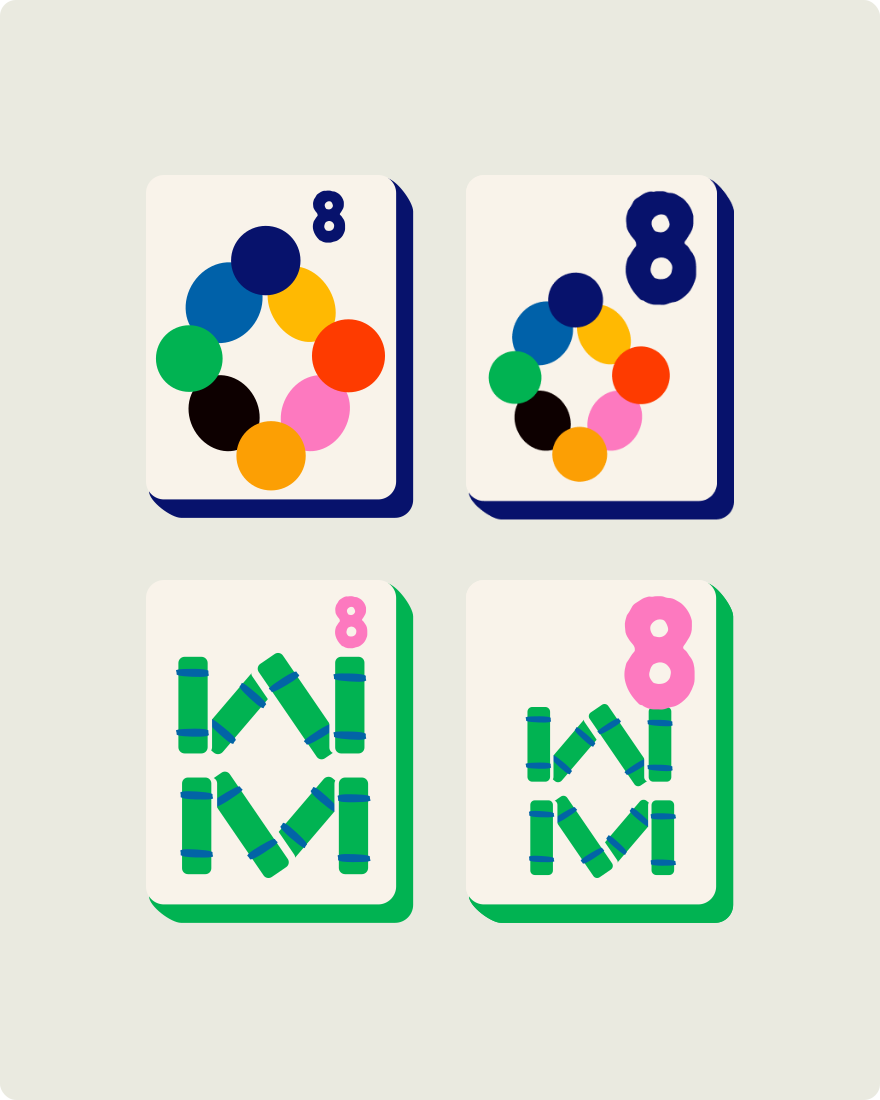
Every tile set has a large number option.
Accessibility wasn't about making everything bigger.
We knew some players would need more help reading their tiles. Increasing the app’s text size wouldn’t solve that.
The thing that needed to be more legible was the tile itself.
We designed a tile set with larger, easier-to-read numbers.
Visibility into what other players are doing in social games helps us know the game is working.
In multiplayer, waiting needed an interface.
With AI players, the game responds immediately. With real people, a pause could mean someone was thinking, deciding whether to call a tile, or the game had stalled.
We needed to make the difference visible.
We designed states that show whose turn it is, when someone is thinking, and when the game is waiting on another player.
You should never have to wonder if the game is broken.
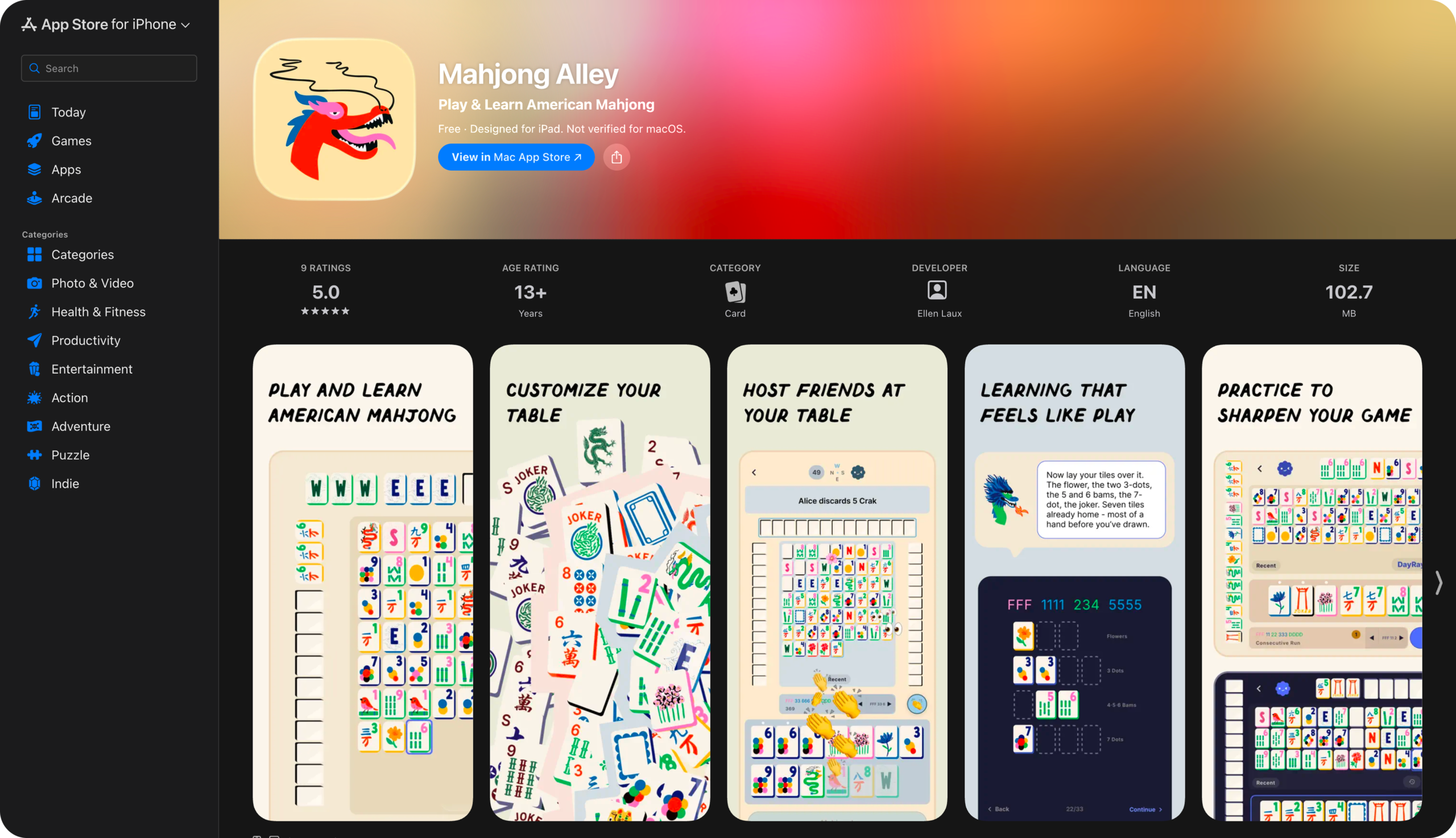
Mahjong Alley in the app store.
Shipping gave us a different kind of feedback.
Before launch, our quality bar was largely our own: Does this work? Does it feel like Mahjong Alley? Is this something only we could dream up?
Now we can see where the product is working — and where it isn't.
The clearest signal so far: people who get into the game tend to keep playing. Getting them there is harder.
About 4 in 10 finished games are followed by another within 30 minutes. But only 16 of our first 80 new players finished their first game.
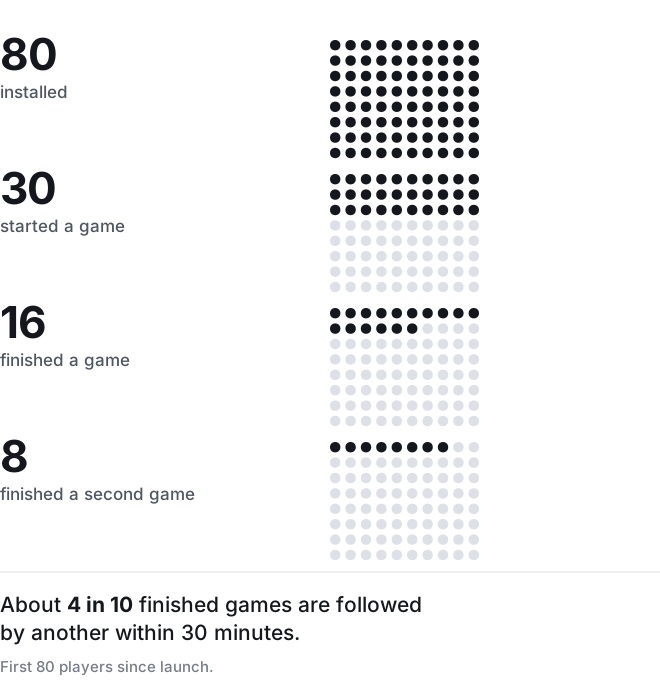
So, what do we work on next?
The data changed the questions we're asking:
How do we get more people confidently into their first game?
What role should learning play?
Once a player is there, what gives them a reason to come back?
The earliest signals are pointing us back to learning.
Of the 21 new players who started a lesson, 13 went on to start a game.
Players who use lessons are also playing and returning more often than those who don't. The groups are small and self-selecting, so we're not treating that as causation.
But it’s enough of a signal to keep investing in learning.
One thing we’re exploring next is Daily Drill: a few minutes of practice designed to build pattern recognition and rack-sorting skills.
It gives us a way to explore both sides of what we're seeing: help people get better at mahjong, and give them a reason to come back.
Daily puzzles to help players get better at Mahjong, and give them a reason to come back.
Mahjong Alley is live.
And very much still becoming Mahjong Alley.